Wearda Charge on Credit Card [Identified]

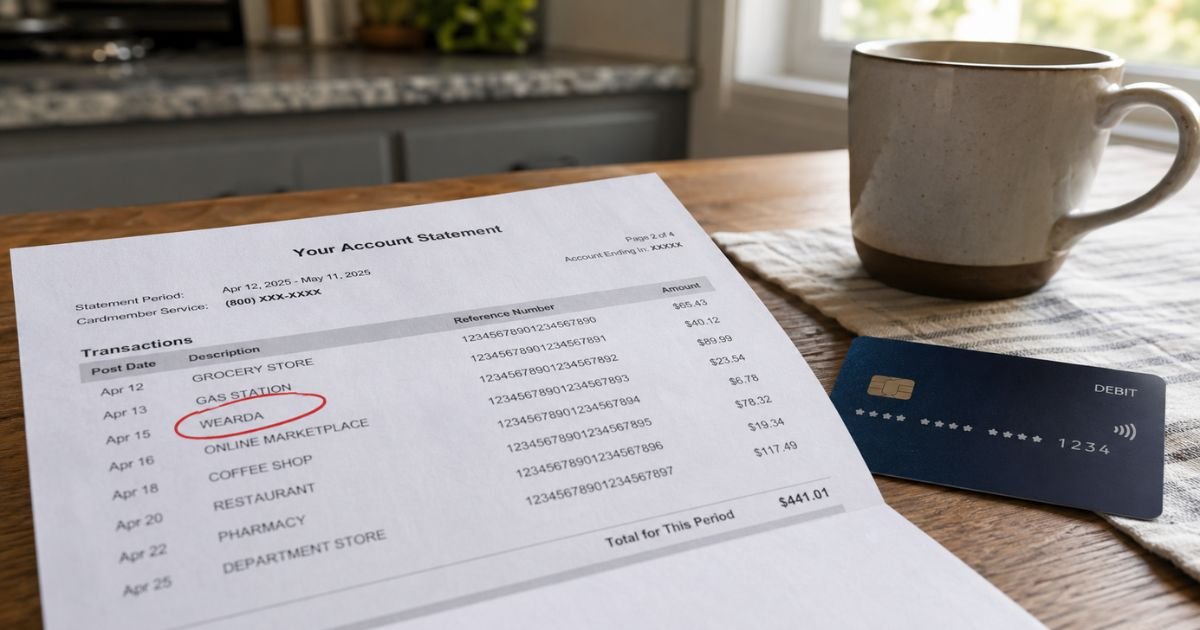
A Wearda charge on credit card can feel confusing if you don’t recall signing up for anything. Unfamiliar charges are often legitimate purchases that just use a short or misspelled billing name.
This guide explains what a Wearda line item typically is, how to match it to an order, and what to do if you still don’t recognize it.
What Is the Wearda Charge on Credit Card?
A Wearda charge on credit card is a merchant descriptor. That is the short name your bank prints next to a purchase. Banks often shorten, misspell, or split a brand name, so “Wearda” may not match the website you remember.
There is no single, well-known US company that clearly markets itself as “Wearda.” Public records and consumer reports more often point to similar clothing names.
Those include Weard at weard.com, a Stockholm-based bamboo underwear brand, and Wearkoda or Koda at wearkoda.com, an online basics clothing shop.
Weard lists support at hello@weard.com and describes itself as an underwear and basics maker. Wearkoda/Koda presents itself as a men’s and women’s clothing store with low sale prices. Some shoppers later see extra charges they did not expect.
Treat “Wearda” as a clue, not a confirmed brand. Check the date, dollar amount, and any city or URL on the same line. Those details usually tell you more than the name alone.
Why This Charge Shows Up
Most people see this after an online clothing order, an Instagram or Facebook ad, or a checkout they started and then forgot. The first charge is often a small sale price. A later charge may be tax, shipping, a second attempt, or a higher amount some shoppers describe as unexpected.
A pending hold can also look like a finished charge. Hotels, gas stations, and some online checkouts place a temporary hold first. That hold typically drops off or changes once the final amount posts. Timing may vary by issuer.
A family member or saved card in a digital wallet can create the same line item. If you share a card, start there before you assume fraud.
| What you may see | What it often means |
|---|---|
| WEARDA, WEARD, WEARD.COM | Possible Weard underwear order |
| WEARKODA, KODA, KODA SHOP | Possible Wearkoda/Koda clothing order |
| WEWARD or WWD | Possible WeWard walking-app purchase |
| Pending + same amount later | Hold that later posts as the real charge |
Names on this table are common lookalikes, not a guarantee. Your issuer may print a different string.
How Wearda Differs From Similar Names
Weard is a real retail site with a public FAQ and an email contact. Reviews are mixed. Some buyers like the products. Others report late delivery or slow replies. That is different from a charge that appears with no order at all.
Wearkoda/Koda is a newer clothing storefront. Trustpilot reviews are strongly negative as of late August 2026, with a very low score and many reports of missing packages and extra card charges.
BBB Scam Tracker also has consumer reports naming wearkoda.com after a first cheap order and a second, larger charge. Those reports are consumer accounts, not court findings.
WeWard is a walking-rewards app. Optional in-app purchases can hit a card through Apple or Google, or sometimes as WeWard. That is a different product from clothing.
If your statement only says “Wearda,” do not guess. Match the amount to an email receipt first.
How to Verify a Wearda Charge on Your Statement
Open the transaction in your bank or card app. Write down the exact descriptor, date, amount, and any phone or website shown. Search that exact text in quotes.
Then search your email for the same amount. Look for subject lines like “order confirmation,” “receipt,” or “shipping.” Check spam. Many clothing sites send mail from a domain that does not match the statement name.
Check PayPal, Apple Pay, Google Pay, Shop Pay, and Klarna if you use them. A charge can post under the processor or the store, not both.
Pro Tip: Screenshot the full transaction before you call anyone. Include the last four digits of the card, the post date, and the reference number if your issuer shows one.
If you find a matching Weard order, email hello@weard.com with the order number and ask what the charge covers. Do not send your full card number.
For Wearkoda/Koda, public reviews say support is often hard to reach. If you cannot get a reply, move to your card issuer.
What To Do If You Did Not Authorize It
Call the number on the back of your card. Ask the issuer to confirm the merchant’s full name and city. Tell them you do not recognize the Wearda charge on credit card and want it reviewed.
You can also ask the issuer to block future charges from that merchant ID. That is not the same as a formal dispute, but it can stop a repeat attempt.
If goods never arrived, or a second charge posted after a cheap first order, say that clearly. Keep copies of emails, chat logs, and tracking pages that show no movement.
Federal billing-error rules generally give you a window to dispute credit card charges in writing.
Many issuers want notice within 60 days of the statement that first showed the charge. Debit cards can have different timelines. Policies may vary by issuer.
Do not wait for the merchant if you cannot reach them. Start the issuer process while the facts are fresh.
How to Stop Recurring or Repeat Charges
First decide whether this looks like a one-time store purchase or a repeating bill. Clothing sites sometimes run a second charge days or weeks later.
Some shoppers describe those extras as “subscription” style even when they never meant to join a club. That claim is common in Wearkoda reviews. It is not independently confirmed as an official plan.
If you used Apple or Google to pay, cancel inside those account settings as well. Deleting an app does not cancel a store subscription.
If you used a stored card on a website, change the password, remove the card from the checkout profile if you can log in, and then tell your bank to block the merchant.
Common Mistakes: Waiting for a promised shipment before you report a second charge. Ignoring a small first charge because it looks like a trial. Calling a number printed only on a website you already distrust. Use the number on your card instead.
Refunds and Chargebacks, Without Guesswork
A refund is money the merchant sends back. A chargeback is your issuer pulling the charge after a dispute. They are not the same thing.
No public official policy promises a refund for every Wearda-style charge. Weard’s FAQ mentions a double-withdrawal question, which suggests duplicate billing can happen, but the live page does not spell out a guaranteed fix.
Wearkoda product pages mention a 30-day money-back line. Shopper reports say that promise is often hard to use when support does not answer. Treat those pages as claims, not results.
If the merchant issues a refund, ask how long it takes to post. Card refunds typically take several business days. Timing may vary by issuer.
If you file a dispute, give the issuer a simple timeline: date of first charge, what you ordered if anything, what you received, and every extra amount. Do not inflate the story. Clear facts help more than anger.
How to Protect the Rest of Your Card
Watch the account for a few billing cycles. Scam-style clothing sites sometimes retry a declined charge.
If you entered the card on a site you no longer trust, consider asking for a new card number. That is your choice. It is often faster than chasing every retry.
Review other small clothing charges from the same week. Ad-driven shops often use more than one store name.
Set transaction alerts in your banking app. A same-day ping is easier to catch than a paper statement weeks later.
FAQs About Wearda Charge on Credit Card
Q: What is the Wearda charge on my credit card?
It is typically a shortened merchant name for an online purchase, most often clothing. It may relate to Weard, Wearkoda/Koda, or another similar brand. Confirm with the date, amount, and any receipt in your email. The exact company is not always clear from the descriptor alone.
Q: Is a Wearda charge always fraud?
No. Many unfamiliar charges are real orders with odd billing names. Still, extra charges after a cheap clothing ad are a common complaint for Wearkoda-style sites. Verify the purchase before you assume either outcome.
Q: How do I cancel a Wearda subscription?
First confirm there is a subscription at all. Search your email and app-store subscriptions. If you cannot log into the merchant site, call your card issuer and ask them to block that merchant. Do not rely on deleting an app.
Q: How long do I have to dispute the charge?
For many credit cards, you generally need to report a billing error within 60 days of the statement that first listed it. Your issuer can tell you the exact cutoff. Act sooner if you can.
Conclusion
A Wearda charge on credit card is usually a billing label, not a full company profile. Match it to a receipt when you can. If you cannot, use your card issuer’s dispute path and watch for repeat attempts.
Unfamiliar does not always mean fraudulent, but you do not have to leave a mystery charge sitting there.
Disclaimer: This article is for general information only. It is not financial, legal, or tax advice. Merchant names, refund rules, and dispute deadlines may vary by company and card issuer. Confirm details with the merchant, if you can reach them, and with your bank before you act.